Home / Tree Trimming & Pruning
Rome, GA & Floyd County — Routine Tree Care
Tree Trimming and Pruning in Rome, GA
Trimming and pruning are often used interchangeably, and for most homeowner purposes, that’s fine. Both refer to selectively cutting branches to manage a tree’s health, shape, or clearance.
This page covers what tree trimming and pruning accomplishes. It explains why technique matters. It also covers when trimming becomes a safety issue.

Tree Trimming and Pruning: What It Actually Accomplishes
Professional pruning generally falls into a few categories, often combined in a single visit:
Crown cleaning — removing dead, dying, diseased, or weak branches. This is often the most important category from a safety and tree-health standpoint, even though it’s the least visually dramatic.
Crown thinning — selectively removing some branches throughout the canopy. It increases light and airflow. It also reduces wind resistance without changing the tree’s shape or size.
Crown raising — removing lower branches to create clearance above a driveway, walkway, or structure.
Crown reduction — reducing the tree’s height or spread. Done correctly, it means cutting back to appropriate lateral branches, not making arbitrary cuts partway through limbs.
A good tree trimming and pruning plan combines the cuts that address your concerns. Those may be safety, clearance, tree health, or appearance. It doesn’t apply one generic cut pattern to every tree.
Regular tree trimming and pruning also follows the ANSI A300 pruning standards used industry-wide.
Pruning Terms Explained
If you’re getting quotes or talking with an arborist, a few terms come up often enough that it helps to know what they actually mean:
The “3 D’s” — a common shorthand for what crown cleaning targets: dead, damaged, and diseased wood. This is usually the first priority in any pruning plan, since it addresses the most safety-relevant material first.
A reduction cut — a cut made back to a lateral branch large enough to take over growth of the limb. It is not a cut to a stub. This is what separates proper crown reduction from topping.
A proper pruning cut angle.
Cuts are generally made just outside the branch collar. That’s the slightly raised area where a branch meets the trunk or a larger limb. They aren’t made flush against the trunk, and they don’t leave a long stub.
Cutting at the correct point allows the tree to seal the wound properly; cutting flush or leaving a stub both slow healing and invite decay.
Codominant stems — two or more main trunks or leaders growing from roughly the same point, often at a narrow angle.
This structure is more prone to splitting than a single dominant leader, especially as the tree matures and the stems grow heavier. → Full breakdown of codominant stems and structural weakness
Knowing these terms isn’t necessary to hire someone competently, but it helps when comparing what different providers are actually proposing to do.
Why Technique Actually Matters
Never top a tree. Topping — cutting main branches or the leader back to stubs, often to reduce height quickly — is a widely discouraged practice among arborists.
It creates large wounds that heal slowly and invite decay and disease. It triggers weak, fast-growing regrowth that’s more hazard-prone than the original branches. It can permanently damage a tree’s health and structure.
If a tree needs significant height reduction, proper crown reduction achieves a similar result. It cuts back to appropriate lateral branches, without the long-term damage.
Cut placement matters for healing. Improper cuts, made too close to or too far from the trunk, heal more slowly. They create larger entry points for decay and pests than cuts made at the branch collar.
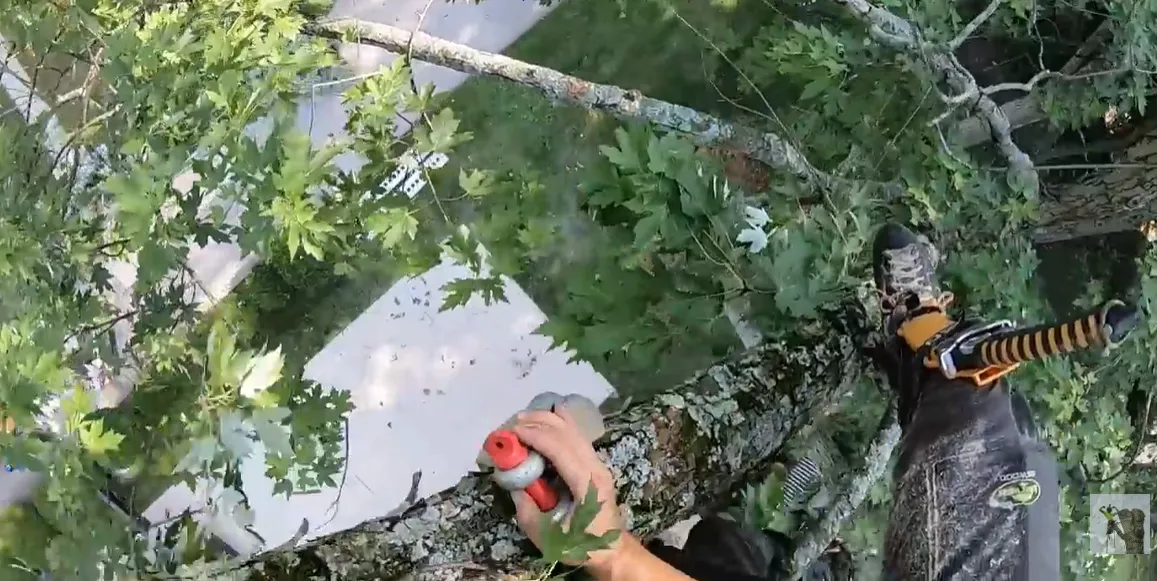
Working at height carries real risk. Beyond technique, pruning larger or taller trees often involves climbing or aerial equipment.
This is part of why professional pruning is the safer choice. A homeowner with a ladder and pole saw should handle only small, easily reachable branches.
Free written estimate — call now, day or night.
📞 Call Now: (762) 470-0249Best Timing for Pruning
Most structural pruning is best done in a tree’s dormant season. The tree is under less stress. The branch structure is easier to see without full foliage.
That said, dead, damaged, or hazardous branches can and should be removed whenever they’re identified, regardless of season. Waiting for “the right time of year” isn’t worth the risk if a branch is already a hazard.
When Trimming Becomes a Hazard Concern, Not Routine Care
- Branches growing into or near a power line are not a routine trimming matter. This becomes a utility safety issue. → Full power line safety guidance
- Significant deadwood over a walkway, driveway, or roof moves from “nice to clean up” toward “should be addressed soon,” particularly on a larger tree
- A tree showing broader hazard signs — not just branches needing shape work. But a lean, cracking, or root issues — needs a risk assessment, not just a trim. → Full hazard-sign guide
Cost
Trimming and pruning are typically priced differently than removal. Often based on tree size, the scope of work, and access, rather than the same cost drivers as a full removal. → Full removal cost breakdown, for comparison
Not sure if it’s urgent? Call and describe it — free advice, no pressure.
📞 Call Now: (762) 470-0249Rome & Floyd County Context
Regular tree trimming and pruning is one of the more effective ways to reduce storm risk. This applies to mature trees in Rome’s older neighborhoods. It can avoid removing a healthy tree altogether.
If you’re specifically trying to prepare trees ahead of storm season, there’s a more targeted approach worth knowing about. → Storm-preventive tree trimming
This applies across Rome (ZIP codes 30161, 30162, 30165) and surrounding Floyd County communities including Armuchee, Cave Spring, Lindale, and Shannon.
Get a Local Estimate
Tell us about the tree and what you’re hoping to accomplish. We’ll connect you with an available local crew for tree trimming and pruning in Rome and Floyd County.
Preparing for storm season? See storm-preventive tree trimming.
How to Plan Tree Trimming: Step by Step
- Pick the right season. Late winter dormancy is best for most species. Avoid heavy pruning of oaks in spring.
- Mark the problem limbs. Note dead, damaged, and diseased limbs first, then limbs over the roof or wires.
- Limit how much is removed. Do not take more than about 25% of the live canopy in one year.
- Leave utility clearance to the utility. Limbs near power lines must be trimmed by the utility or a line-clearance crew.
- Hire a qualified crew. Ask for insurance proof and an ISA-certified arborist for large or valuable trees.
Latest Articles
- Tree Trimming vs Removal: How to Decide
- Best Time to Trim Trees in Georgia
- Trimming Overhanging Branches: What You Can Cut and What to Leave
Related Guides
- Branches Over Your Roof: When to Prune and When to Remove
- Who Trims Trees Near Power Lines in Georgia?
- Trimming Overhanging Branches
- Best Time to Trim Trees in Georgia
- Tree Trimming vs Removal: How to Decide
Frequently Asked Questions
How often should mature trees be pruned?
It varies by species, age, and condition — there’s no single universal schedule. An arborist can recommend a reasonable interval for your specific trees based on their health and growth pattern.
Is it bad to prune a tree in summer?
Not necessarily for removing dead or hazardous branches, which should happen whenever needed regardless of season. Larger structural pruning is often better suited to the dormant season, but summer pruning isn’t inherently harmful for smaller, targeted work.
What’s wrong with just cutting a tree shorter to control its size?
That’s called “topping”. It cuts main limbs back to stubs, not to lateral branches. It creates decay-prone wounds and triggers weak regrowth that’s often more hazardous than the original structure.
Proper crown reduction achieves height control without that damage.
Can I prune my own trees, or should I always hire someone?
Small, easily reachable branches on smaller trees are often manageable for a homeowner with the right tools.
Anything requiring a ladder, significant height, or larger cuts is safer with a professional. That protects both the person cutting and the tree’s long-term health.