Part of our guide: Tree Care
Home / Emergency Tree Removal / Exposed or Uprooted Roots
Rome, GA & Floyd County — Root System Assessment
Exposed Tree Roots Hazard: Is It Dangerous?
An exposed tree roots hazard isn’t automatically obvious — plenty of healthy, stable trees have visible surface roots that have simply always been there.
What actually matters is whether those roots are part of a stable system or a failing one.
This page covers how to tell the difference. It also covers a slower-moving risk that doesn’t show up as exposed roots at all: construction damage to a tree’s root zone. Not every exposed tree roots hazard looks dramatic.
If you’re looking at fresh soil heaving, cracking ground, or a tree that’s visibly shifted, treat it as urgent rather than something to monitor.
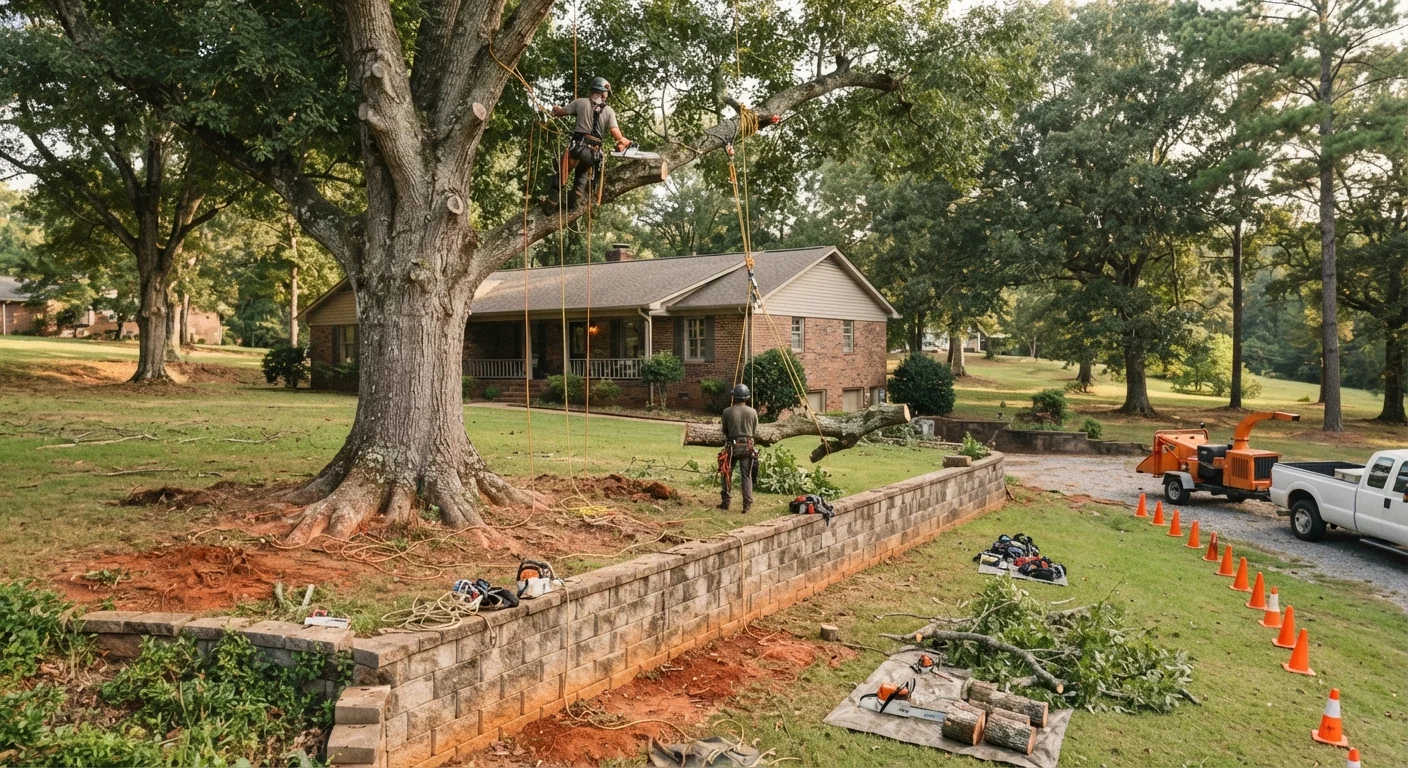
Cosmetic Roots vs. a Real Exposed Tree Roots Hazard
Some trees — especially older ones, and certain species more than others — naturally develop surface roots as they mature. On their own, these roots are typically just a maintenance or landscaping consideration, not a structural warning:
- They’ve been visible for years without changing in position or number
- The tree shows no lean, no soil disturbance elsewhere at the base, and no canopy decline
- They’re more of a mowing or tripping annoyance than anything else
If this describes what you’re seeing, the tree usually doesn’t need to be assessed as hazardous.
Though grading, mulching, or building a small platform around the roots are common ways homeowners manage this without harming the tree. Just don’t cover roots with fill dirt, which can suffocate them.
Root-Plate Failure: When Exposed Roots Are a Real Warning Sign
A “root plate” is the mass of roots and soil that anchors a tree in the ground — think of it as the tree’s foundation. When that foundation starts to fail, it shows up differently than cosmetic surface roots:
- Soil heaving or cracking around the base, especially on the side opposite any visible lean. This is the ground being lifted as the root plate tips
- Roots that have visibly shifted or lifted recently, not roots that have always been at the surface
- A new or increasing lean paired with any of the above. This combination is one of the clearer signs a tree could fail with little further warning
- Soggy or saturated soil around a leaning tree, since wet, softened ground gives roots less to hold onto exactly when wind load is often highest
A tree with genuine root-plate failure isn’t a “watch it for a while” situation. Once the anchoring system starts to give way, the timeline to actual failure can be short, especially during or after another storm. → Full hazard-sign checklist
The Damage You Can’t See: Construction and Grading Root Injury
This is the root problem that doesn’t look like a root problem at first.
A tree’s roots generally extend well beyond the trunk, often close to the edge of the canopy above (sometimes called the drip line). Most of a tree’s fine, function-critical roots sit in the top foot or two of soil.
Closer to the surface than people expect.
That means digging, trenching, grading, or even compacting soil with heavy equipment near a tree can damage a meaningful portion of its root system. That’s true for a driveway, a pool, a utility line, or an addition.
It may leave no visible sign right away.
The tree often doesn’t show symptoms immediately.
Canopy thinning, dieback, or a new lean can show up months or even a few years after the original construction work. That makes the connection easy to miss if you weren’t looking for it.
If a tree near your property has had any digging, trenching, or grade change nearby in the past several years, watch it closely. Is it now showing canopy decline or a new lean? That history is worth mentioning to whoever assesses it.
It may point to an exposed tree roots hazard. It may point to an exposed tree roots hazard.
It changes how the situation is likely to progress.
Free written estimate — call now, day or night.
📞 Call Now: (762) 470-0249Can Roots Actually Damage My Foundation?
This is a different question from root-plate failure, and it’s one of the more common concerns homeowners raise separately from a hazard assessment.
Direct root contact with a foundation is less common than people assume, especially with a poured concrete foundation in reasonably good condition. Established structures generally aren’t easily displaced by root growth alone. Where roots more commonly cause visible problems:
- Sidewalks and driveways — surface and near-surface roots can lift concrete slabs over time, especially with large trees planted too close to hardscaping
- Older or already-compromised foundations — a foundation with pre-existing cracks or drainage issues can be more susceptible to root-related soil pressure than a sound one
- Soil moisture changes near a foundation. Some fast-growing, water-seeking species can dry out soil near a foundation unevenly. That can itself contribute to settling or minor cracking that gets blamed on “roots” when the mechanism is really soil moisture change
How close is too close? There’s no single safe distance that applies to every species.
But as a general rule, larger trees with aggressive root systems are better planted well back from a foundation. Smaller ornamental species are more forgiving at closer distances.
If you’re planting new trees, it’s worth checking a species’ typical mature root spread before deciding on placement near the house.
If you’re seeing foundation cracks and blaming a nearby tree, it’s worth getting both perspectives.
A foundation contractor to assess the crack itself. An arborist to assess whether the tree’s roots are actually a contributing factor or simply a nearby coincidence.
Removing a healthy, otherwise-fine tree because of an assumed connection that turns out to be unrelated is a common regret. A proper assessment first helps avoid it. Assess any exposed tree roots hazard before removing a healthy tree.
What This Means for Removal
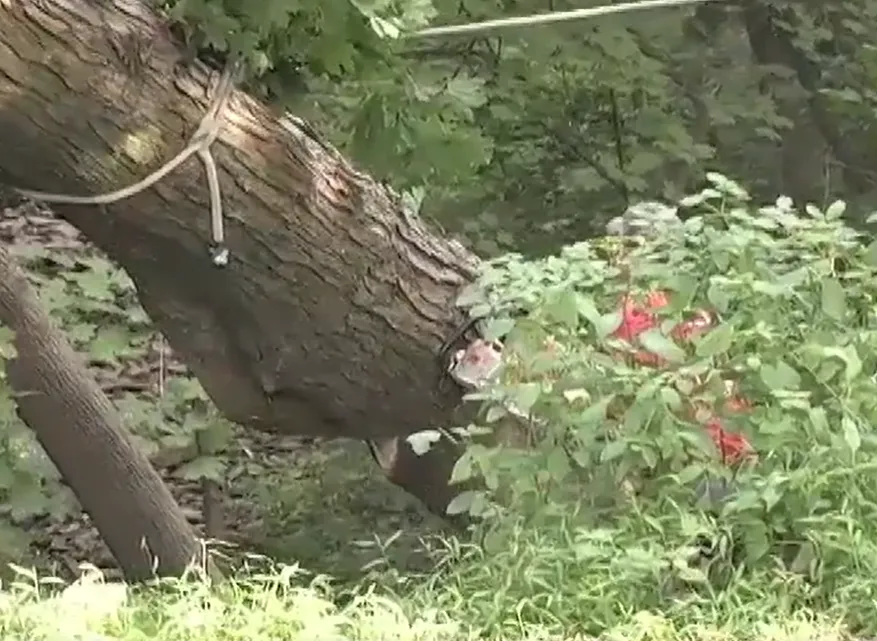
A tree with a compromised root system has to be handled differently during removal than a tree with a healthy, intact root system. That’s true whether the cause is visible root-plate failure or earlier construction damage:
- Directional felling relies partly on the tree’s own remaining anchorage to control how and where it falls. A tree with significant root damage may not behave predictably using standard technique, which often means more reliance on rigging and sectional removal instead.
- Ground stability near the tree can itself be compromised. Equipment access may be more limited than usual. So may where a crew can safely stand or position machinery. An exposed tree roots hazard also changes how a crew sets up.
- A rushed removal on a root-compromised tree carries more risk, not less. This is exactly the kind of situation where hiring an experienced crew matters more than usual. → Full removal process breakdown
Rome & Floyd County Context
Floyd County sits in Georgia’s Ridge and Valley region, with clay-enriched subsoil that holds water longer after heavy rain.
A factor that affects root anchorage across the area. It matters most on the hillside terrain around Rome’s seven hills, as opposed to the flatter river-bottom ground near downtown.
This applies across Rome (ZIP codes 30161, 30162, 30165) and surrounding Floyd County communities including Armuchee, Cave Spring, Lindale, and Shannon. → Full local storm context
Not sure if it’s urgent? Call and describe it — free advice, no pressure.
📞 Call Now: (762) 470-0249Cost
Removal cost for a root-compromised tree depends on the same core factors as any removal. It adds the extra care and equipment often needed when standard felling technique isn’t reliable.
An exposed tree roots hazard often raises removal cost. → Full cost breakdown

Get a Local Assessment
Tell us what you’re seeing — we’ll connect you with an available local tree service or arborist serving Rome and Floyd County.
How to Check Exposed Tree Roots: Step by Step
- Look at which roots are exposed. Small surface roots are common. Large structural roots near the trunk matter more.
- Check for soil heaving. Raised or cracked soil on one side can mean the root plate is lifting.
- Look for root damage. Cut, crushed, or rotting roots weaken the anchor. Mushrooms at the base are a warning.
- Check the lean. A new lean plus exposed roots is an urgent combination.
- Get it assessed. Call (762) 470-0249 before digging, cutting roots, or adding soil over them.
Frequently Asked Questions
Should I cover exposed surface roots with soil?
Generally no — piling soil or fill directly over roots can reduce the oxygen they need and stress the tree over time.
Mulch, a thin layer of soil in some cases, or a raised platform around the roots are usually better options than burying them.
How long after construction can root damage show up?
It varies, but symptoms like canopy thinning or dieback sometimes don’t appear for one to several years after the original digging or grading. That’s part of why the connection often gets missed.
Can a tree recover from root damage, or is it always fatal?
It depends on how much of the root system was affected and the tree’s overall health beforehand. Some trees recover with reduced vigor; others decline progressively.
An arborist’s assessment is the most reliable way to judge which path a specific tree is on.
Is a tree with exposed roots automatically more likely to fall in a storm?
Not automatically — it depends on whether those roots represent a stable, mature root system or a failing one. That distinction is exactly what this page is meant to help you make sense of, and a professional assessment settles it definitively.