Home / Tree Trimming & Pruning / Storm-Preventive Trimming
Rome, GA & Floyd County — Getting Ahead of Storm Season
Storm-Preventive Tree Trimming in Rome, GA
Most emergency tree calls in this area trace back to something that was, in hindsight, addressable beforehand. A weak branch union, a load of deadwood, a canopy dense enough to catch far more wind than it needed to.
Preventive trimming before storm season is one of the more effective, underused ways to reduce that risk on your own property.

Storm-Preventive Tree Trimming: Why This Actually Reduces Risk
A few specific things make a real difference in how a tree handles high wind:
- Removing deadwood eliminates branches that have no living structure holding them together. Dead limbs are disproportionately likely to fail first in wind, since they’ve already lost the flexibility and strength living wood has.
- Thinning a dense canopy reduces the tree’s overall wind resistance. A full, heavy canopy catches wind like a sail. A properly thinned one lets more air pass through with less total force on the branch structure.
- Addressing weak branch unions early. A co-dominant union caught and reinforced before a storm is far less likely to fail than one left alone until wind load finally breaks it.
- Reducing weight on long, heavy limbs lowers the leverage and stress on the point where that limb meets the trunk. That’s often exactly where storm failures start.
None of this makes a tree storm-proof. Nothing does. But it meaningfully shifts the odds in a tree’s favor before wind and rain test its structure.
This kind of storm-preventive tree trimming reflects the ANSI A300 pruning standards followed by professional arborists.
Never Top a Tree to “Storm-Proof” It
This is worth being direct about. Some homeowners cut a tree’s height back aggressively, called topping. They believe a shorter tree is automatically a safer one in a storm. It’s the opposite of what actually helps.
Topping creates large, slow-healing wounds vulnerable to decay. It also triggers weak, fast-growing regrowth that’s more prone to failure than the tree’s original branch structure, not less.
A topped tree is often a more hazardous tree within a few storm seasons, not a safer one.
If overall size genuinely needs to be reduced, proper crown reduction accomplishes similar practical goals without the long-term structural damage. That means cutting back to appropriate lateral branches rather than to stubs.
When to Do This
Given Rome’s storm pattern, the most damaging events typically arrive in spring and summer. Late winter through early spring is generally the most useful window for preventive pruning. That’s when storm-preventive tree trimming pays off most.
After the worst of winter weather but before storm season ramps up. Often the tree is still in or near dormancy. That makes structural issues easier to see clearly without full foliage.
This isn’t something to try to squeeze in right before a specific storm is forecast. Major pruning work takes planning and, for larger trees, real time to do properly — it’s a seasonal preparation step, not a last-minute one.
Dead or broken limbs over a roof can be handled any time — don’t wait for a season. For a full season-by-season guide, including storm season, the May 1 – Sept 30 burn ban and pine beetle timing, see seasonal tree care in Rome, GA.
Storm damage right now? We answer 24/7.
📞 Call Now: (762) 470-0249What a Pre-Storm Assessment Actually Looks At
- Deadwood throughout the canopy, not just what’s obviously visible from the ground
- Weak branch unions, particularly co-dominant stems. They haven’t failed yet but show the structural pattern that tends to fail under wind load → Full hazard-sign guide
- Overall canopy density relative to the tree’s size and species — some trees naturally benefit more from thinning than others
- Any tree already flagged in a prior risk assessment as a monitoring case. Check whether targeted pruning now can address the concern → Full risk assessment guide
- Whether a specific weak point is better addressed with pruning, or needs cabling or bracing instead → Cabling and bracing
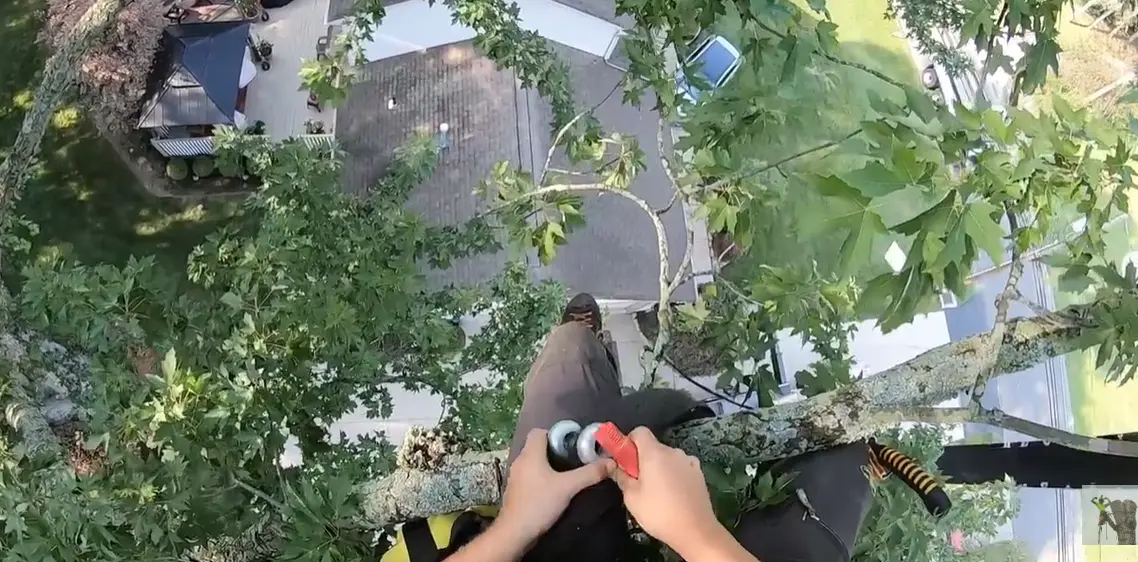
Who Should Do This
The same credentials that matter for risk assessment matter here.
An ISA-certified arborist or someone with structural pruning experience is a reasonable thing to ask about. That’s particularly true for larger or more valuable trees where getting the cuts right matters more than a quick trim would.
Cost
Preventive pruning is typically far less expensive than emergency removal after a storm-related failure. It’s priced based on tree size and scope of work rather than the urgency-driven factors that affect emergency pricing. → Compare to emergency removal cost
Free written estimate — call now, day or night.
📞 Call Now: (762) 470-0249Rome & Floyd County Context
Rome and Floyd County see damaging storm events consistently each spring and summer. That includes the May 2025 storm that damaged seven homes and brought down power lines across the area.
A modest preventive pruning investment ahead of that season is one of the more practical ways local homeowners reduce their own risk.
This applies across Rome (ZIP codes 30161, 30162, 30165) and surrounding Floyd County communities including Armuchee, Cave Spring, Lindale, and Shannon. → Full local storm context
Get a Storm-Preventive Tree Trimming Assessment
Tell us about your property — we’ll connect you with an available local arborist or tree service serving Rome and Floyd County.
How to Prepare Trees Before Storm Season: Step by Step
- Walk your property early. Check trees in late winter or early spring, before the main storm season.
- Spot weak structure. Look for dead limbs, cracks, V-shaped forks, and limbs hanging over the roof.
- Thin and reduce, do not top. Proper thinning lowers wind load. Topping weakens the tree and creates new hazards.
- Clear the roofline. Remove limbs touching or hanging close over the house and gutters.
- Schedule the work. Call (762) 470-0249 for a pre-storm trimming estimate.
Related Guides
Latest Articles
- Tree Trimming vs Removal: How to Decide
- Best Time to Trim Trees in Georgia
- Trimming Overhanging Branches: What You Can Cut and What to Leave
Frequently Asked Questions
How far in advance of storm season should I get trees trimmed?
Late winter to early spring generally gives enough lead time before Rome’s typical spring and summer storm activity picks up. It still allows dormant-season pruning benefits.
Does preventive trimming guarantee my trees won’t fail in a storm?
No — nothing eliminates storm risk entirely. Preventive pruning meaningfully reduces the odds of common failure patterns, like dead branch drop or weak-union splits. But it isn’t a guarantee against a severe enough event.
Is it worth trimming a tree that already looks perfectly healthy?
Often yes, particularly for larger, older trees. Deadwood and weak unions aren’t always obvious from the ground, and a preventive assessment can catch developing issues before they become visible problems.
Should I trim my trees myself before a storm to save money?
For small, easily reachable branches, homeowner trimming can be reasonable.
For anything involving height, larger limbs, or structural pruning decisions, professional work reduces the safety risk to you. It also reduces the risk of improper cuts (including accidental topping) that can do more harm than good long-term.