Home / Emergency Tree Removal / Split or Cracked Tree Removal
Rome, GA & Floyd County — Structural Failure Response
Split Cracked Tree Removal in Rome, GA
Split cracked tree removal is often urgent, because the failure has already started. It’s a question of how much further it goes and how fast.
This page covers what usually causes it. It shows how to tell a manageable crack from a genuine emergency. It also covers what happens once removal (or, sometimes, repair) is the right call.
A split or cracked tree can be holding significant stored tension. Don’t attempt to cut, pull, or climb it yourself — even a “small” split section can release with enough force to cause serious injury.

What Usually Causes a Split Cracked Tree in Rome
Splits and cracks are almost always a mechanical failure under load, and Rome’s storm pattern creates plenty of opportunities for it:
- Wind load on a full canopy. A tree in full leaf catches far more wind than a bare one. That’s part of why spring and summer storms here cause more splitting than winter wind events
- Rain-saturated soil combined with wind. After heavy rain, softened soil gives roots less to anchor against, which can shift how stress loads onto the trunk and limb unions
- Weak branch unions (included bark). Some trees naturally grow limbs that meet the trunk at a tight, V-shaped angle with bark pinched inside the union rather than solid wood-to-wood contact. These unions are structurally weaker from the start and are a common site for splits during storms
- Heavy limb weight over time. A large horizontal limb, especially one that’s grown longer than others, puts constant leverage on its union point. Storms are often just the final trigger
- Prior decay: a limb union or trunk section already weakened by internal decay is far more likely to split. A healthy tree would tolerate the same wind load
Types of Splits Worth Knowing
Co-dominant leader split
This happens where a tree has grown two (or more) main trunks of similar size instead of one dominant leader. They meet at a narrow, weak union.
It’s one of the most common split patterns and one of the more predictable ones. Trees with this structure are worth watching before a storm ever happens.
Why codominant stems are a structural concern in the first place. When two leaders grow at a tight angle, bark can get pinched inside the union. The wood doesn’t fuse solidly together.
This is called included bark, and it means the union is held together by comparatively weak tissue instead of continuous wood.
As both leaders grow larger and heavier over the years, the leverage on that weak point increases. That’s exactly why older trees with this structure are more prone to splitting than young ones with the same growth pattern.
Split cracked tree removal often follows when that structure fails. Split cracked tree removal often follows when that structure fails.
A tree with codominant stems isn’t automatically a hazard. Plenty stand for decades without incident. But it’s a structural feature worth an arborist’s opinion, especially if the tree is large, mature, and near a structure.
Sometimes early cabling can reduce the risk without removing anything. → Full guide to cabling and bracing
Limb tear-out
A large limb separates from the trunk, sometimes taking a strip of trunk bark and wood with it. This leaves an open wound that’s vulnerable to decay and pests going forward, in addition to the immediate hazard of the limb itself.
Full trunk crack
A vertical crack running through a significant portion of the trunk. It’s sometimes visible from the outside, sometimes only found when a section of bark has already come loose.
This is generally the most serious type, since it affects the tree’s core structural support.
Partial or hairline crack
A smaller crack that hasn’t fully separated the wood. These can sometimes be monitored or addressed with cabling if caught early, but they can also progress quickly under the next wind load.
Which is why “small” and “safe” aren’t the same thing here.
How Serious Is It? Signs That Push Toward Immediate Removal
- The crack or split runs into solid, healthy-looking wood rather than just surface bark
- There’s any visible movement or widening when wind blows through the canopy
- A limb is partially attached and hanging — sometimes called a “hanger” or “widowmaker” — since it can fall with no additional warning
- The split affects a large portion of the trunk’s cross-section rather than a smaller limb
- Fungal growth, soft wood, or discoloration is visible inside or around the crack, suggesting decay was already present before the split happened
If any of these apply, this moves from “watch it” to “get it assessed now.” That’s especially true if the tree is near a house, driveway, or anywhere people regularly walk or park. → Full hazard-sign checklist
Not sure if it’s urgent? Call and describe it — free advice, no pressure.
📞 Call Now: (762) 470-0249Can a Split Tree Be Saved?
Sometimes.
Early-stage co-dominant unions or smaller partial cracks can sometimes be stabilized with cabling or bracing hardware. This works especially when they’re caught before they’ve widened significantly and without visible decay.
The hardware reduces movement and stress on the weak point. Split cracked tree removal isn’t always the first step.
This isn’t a fix for every split, and it generally isn’t appropriate once a crack has progressed significantly or decay is already present. → Full guide to tree cabling and bracing
When the split is extensive, involves major structural wood, or shows signs of internal decay, removal is typically the safer and more practical path.
Trying to preserve a tree that’s already structurally compromised in a major way tends to just delay an eventual failure.
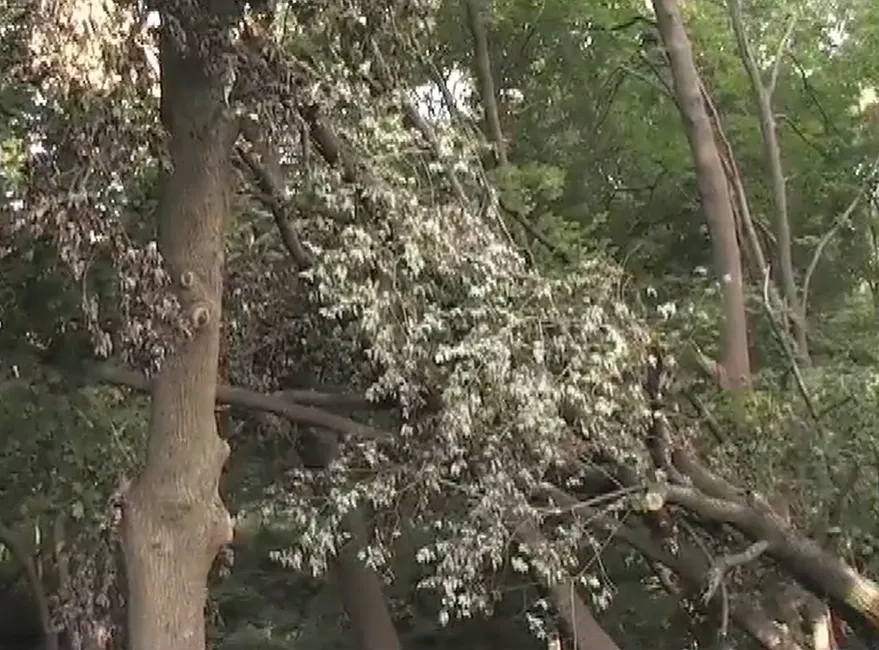

What Split Cracked Tree Removal Looks Like
This isn’t handled the same way as felling a healthy, intact tree:
- Assessing stored tension first. A split section can be under significant spring load — bent, twisted, or partially supported by the intact wood around it. This has to be understood before any cutting starts.
- Securing or supporting the split section, sometimes with rigging, before it’s fully separated, so it doesn’t drop unpredictably mid-cut.
- Controlled sectional removal of the split portion first, then the remainder of the tree if full removal is needed.
- Careful attention to the tree’s remaining stability throughout. Removing a split section can shift the balance of what’s left, especially if the tree is being partially preserved rather than fully removed.
This is one of the more technical removal scenarios, and it’s a reasonable one to ask directly about a crew’s experience with before hiring. Not every tree service handles high-tension, partially-failed wood the same way. → Full general removal process
Cost and Insurance
Split-tree removal is often priced similarly to standard removal. It can run higher if extensive rigging or a slower, more careful technique is required due to stored tension. Split cracked tree removal cost varies by job.
Split cracked tree removal cost varies by job. → Full cost breakdown
If the split happened during a storm and caused damage to a structure, vehicle, or blocked access, the same insurance principles apply. They’re the same as for any other storm-related tree damage. → Full insurance breakdown
Tree emergency near you? A local crew is one call away.
📞 Call Now: (762) 470-0249Rome & Floyd County Context
Split and cracked trees show up often after Rome’s spring and summer storm systems. They’re most common on mature hardwoods with weak branch unions. Those unions develop for years before a storm finally puts enough load on them to fail.
This applies across Rome (ZIP codes 30161, 30162, 30165) and surrounding Floyd County communities including Armuchee, Cave Spring, Lindale, and Shannon. → Full local storm context