Tree Care Glossary & Resources
Resources — Rome & Floyd County, GA
Tree workers use a lot of jargon. This page explains it in plain English.
Use it when you read a quote, talk to a crew, or deal with your insurer.
Tree Care Glossary: Parts of a Tree
- Crown — The top of the tree: limbs, branches and leaves.
- Canopy — The spread of the crown. Often used for the shade area.
- Trunk — The main stem.
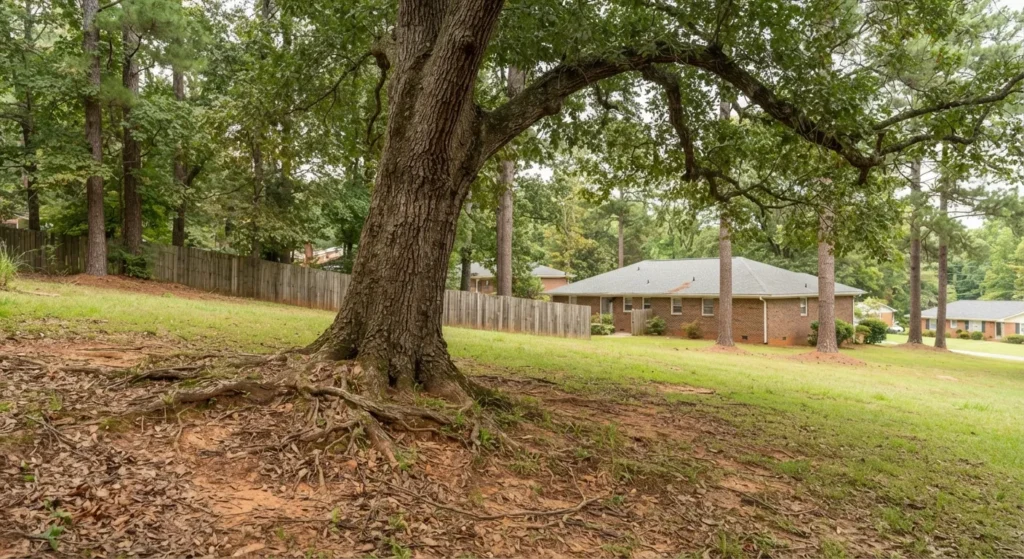
- Root flare — Where the trunk widens into roots at ground level. Decay here is serious.
- Drip line — The ground under the edge of the canopy. Roots go well past it.
- Leader — The main upward stem. Trees with two “codominant leaders” can split.
- Union / crotch — Where a limb joins the trunk.
Problems & Risk Terms
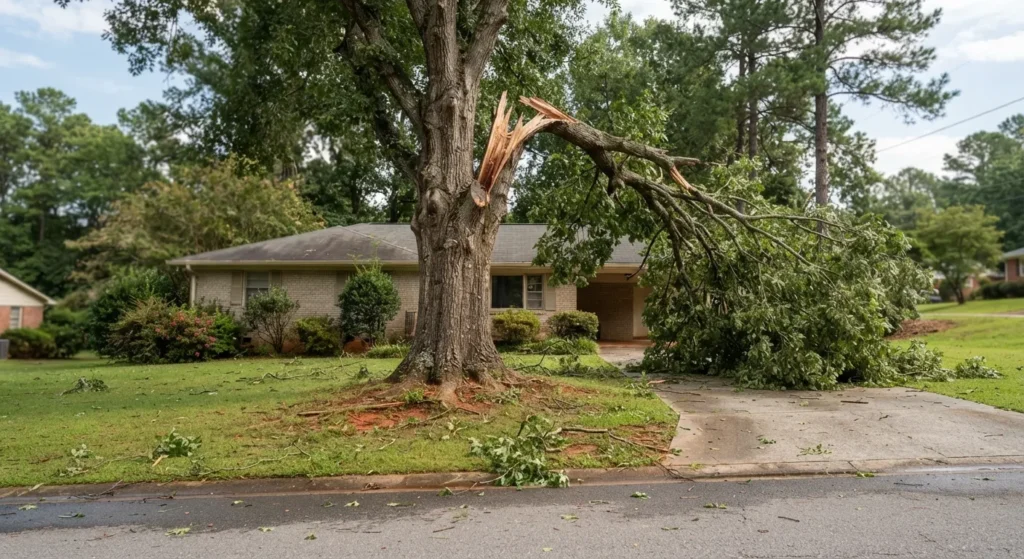
- Hazard tree — A tree with a defect that could fail and hit something.
- Deadwood — Dead limbs in the crown.
- Widowmaker — A broken limb hanging loose in the tree.
- Heart rot — Decay inside the trunk. See oak trees.
- Included bark — Bark trapped in a tight union. A weak point.
- Pitch tubes — Sap blobs from bark beetle attacks. See pine trees.
- Hypoxylon canker — Fungus that kills stressed oaks.
- Root plate failure — When the whole tree tips over, roots and all.
Work & Service Terms
- Felling — Cutting a tree down in one piece.
- Sectional removal — Taking a tree down in pieces. Used near houses. See large tree removal.
- Rigging — Ropes used to lower cut pieces safely.
- Crane removal — Using a crane to lift sections out.
- Crown thinning — Removing some branches to cut wind load.
- Crown raising — Removing low limbs for clearance.
- Topping — Cutting the top off. Most arborists advise against it.
- Stump grinding — Grinding the stump below ground.
- Forestry mulching — Grinding brush and small trees in place. See forestry mulching.
- Lot clearing — Removing trees and brush from land. See lot clearing.
Credentials & Insurance Terms
- ISA Certified Arborist — A credential from the International Society of Arboriculture.
- TRAQ — ISA’s Tree Risk Assessment Qualification.
- General liability insurance — Covers damage the crew causes to your property.
- Workers’ compensation — Covers crew injuries. Ask about it before work starts.
- Certificate of insurance (COI) — Proof of coverage. Ask for one.
Trusted Resources
These are outside organizations. We are not affiliated with them.
- Georgia Forestry Commission — Burn permits, pine beetle info, forest health.
- UGA Cooperative Extension — Tree and landscape guides. Floyd County has a local office.
- Trees Are Good (ISA) — Homeowner guides and arborist search.
- Georgia 811 — Call before digging, including stump removal near lines.
- City of Rome / Floyd County — Local rules, yard waste and permits.
Rules change. Always confirm with the source before acting.
Need Help With a Tree?
Seven Hills Emergency Tree is a referral service, not a tree crew. We connect you with an independent local tree service.
FAQ
What is a hazard tree?
A tree with a defect, like decay or a crack, that could fail and hit a person or property.
What’s the difference between an arborist and a tree service?
An arborist is trained in tree care. A tree service may or may not have one on staff. Ask.
Is tree topping bad?
Most arborists say yes. It causes weak regrowth and decay.
What does “sectional removal” mean on my quote?
The tree comes down in pieces instead of all at once. It’s used when there’s no room to fell it.
Do I need to call 811 before stump grinding?
It’s a good idea. Grinding can go deep. Georgia 811 marks buried utility lines for free.