Part of our guide: Emergency Tree Removal
Home / Emergency Tree Removal / Tree Removal Near a House
Rome, GA & Floyd County — Structural Proximity Planning
Tree Removal Near a House in Rome, GA
Removing a tree that’s standing close to a house is a different job than removing one in open ground. That’s true even when the tree isn’t damaged.
The proximity changes the technique, the equipment decision, and how much has to be protected during the work. This page covers what actually changes when a structure is nearby.
Tree Removal Near a House: Why Proximity Changes Everything
In open ground, a healthy tree can often be felled in one directional cut. The crew controls where it falls, and there’s room for a margin of error. Near a house, that margin disappears.
A tree tall enough to reach the roof, a fence, or a driveway can’t be dropped whole. It has to be taken apart piece by piece.
This is true even for a completely healthy tree with no hazard signs — proximity alone is enough to change the entire approach.
Sectional Removal: How It Actually Works
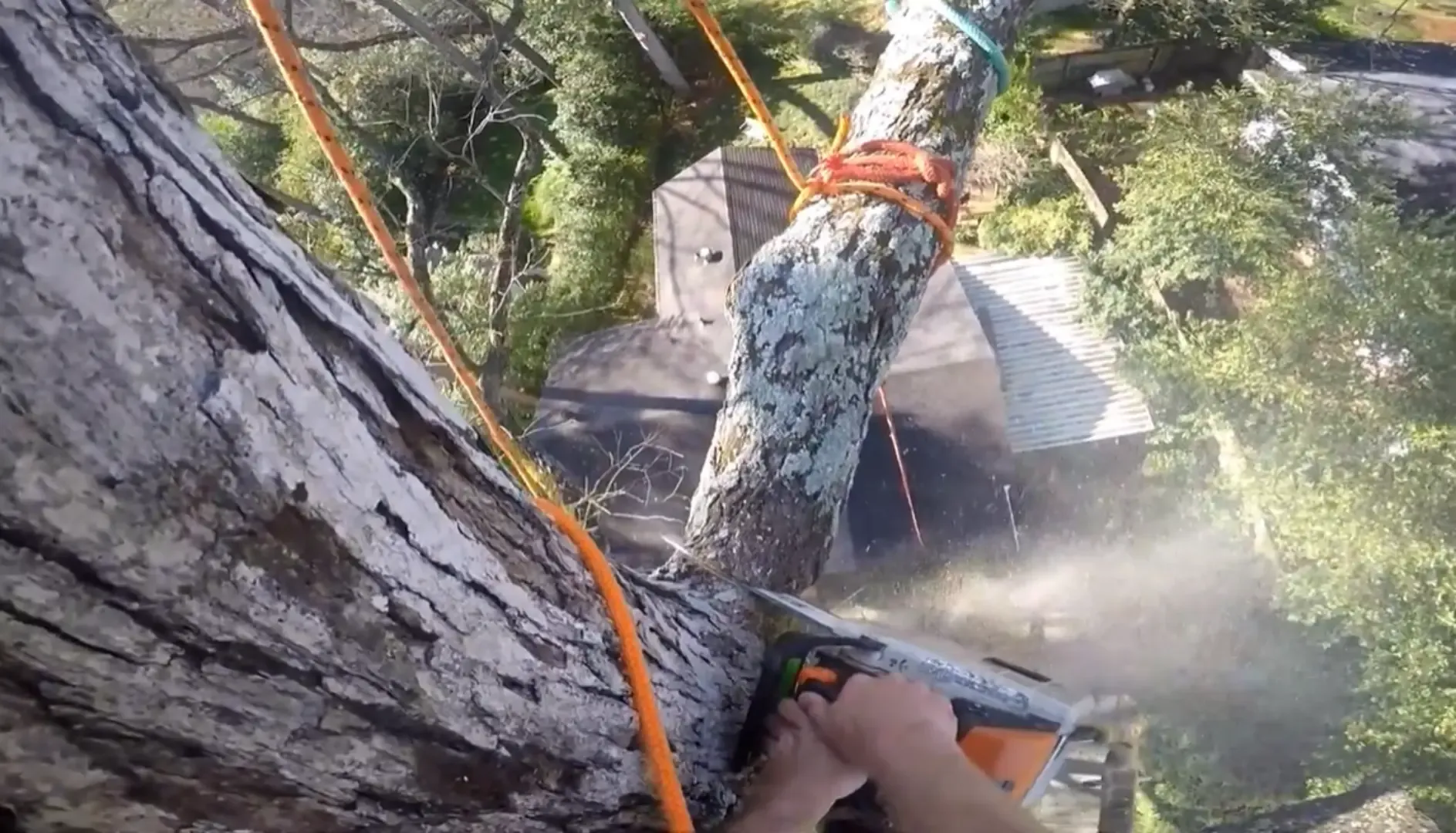
Sectional removal means taking the tree apart from the top down, in controlled pieces, rather than felling it as a whole:
- Climbing or aerial lift access to reach the upper canopy, where the work starts
- Rigging each section — ropes and rigging gear control how a cut piece moves and where it lands, rather than letting gravity decide
- Lowering pieces in a controlled sequence, often to a specific clear landing zone rather than straight down
- Working down the trunk progressively, removing manageable sections rather than the whole trunk at once
- Ground crew coordination — someone below manages the ropes and clears each piece before the next one comes down
This takes considerably longer than a straightforward fell, which is part of why proximity to a structure affects both timeline and cost. Rigging standards for tree removal near a house follow the same safety practices outlined by the Tree Care Industry Association.
When Does a Crane Become Necessary?
Sectional removal with rigging handles most structure-adjacent situations, but a crane becomes the better option when:
- The tree is too tall or too heavy for rigging alone to safely control, especially with large trunk sections
- There’s no safe landing zone for lowered sections. A tight side yard, a pool, or a fence line that would be damaged by rigged pieces coming down
- The tree leans toward the structure in a way that makes controlled directional cutting from the ground or a climber’s position too risky
- Multiple obstacles stack up together — power lines, a narrow gap between structures, and a large tree all at once
A crane lifts sections straight up and away rather than lowering them through the space near the house, which solves access problems rigging can’t. → Full crane removal guide
Not sure if it’s urgent? Call and describe it — free advice, no pressure.
📞 Call Now: (762) 470-0249Protecting Your Property During the Work
A good crew plans for this before starting, not as an afterthought:
- Roof protection — padding or plywood positioned to protect roofing material from falling debris or rigging contact
- Gutter protection — gutters are easy to damage during rigging work if the crew isn’t accounting for them
- Fence and landscaping protection — plywood over walkways, protective barriers around plant beds, and clear staging areas to avoid unnecessary foot and equipment traffic
- A defined debris zone — keeping cut material contained to a specific area rather than scattering it across the yard
Ask what property protection is planned before work starts. This matters most when the tree is close enough to touch the house.
Staging and Access
- Driveway and yard access for equipment. A crane or larger truck needs adequate clearance and a stable surface to operate safely; narrow or steep driveways sometimes limit equipment options
- Street or curb staging, if the property itself can’t accommodate equipment. This sometimes requires brief coordination with neighbors or, for crane work extending over a public sidewalk or street, awareness of right-of-way considerations
- HOA notice, if applicable — some communities have notification requirements for large equipment or extended work. Check your specific HOA guidelines if you’re in a covered neighborhood
Is Removal Always the Right Call?
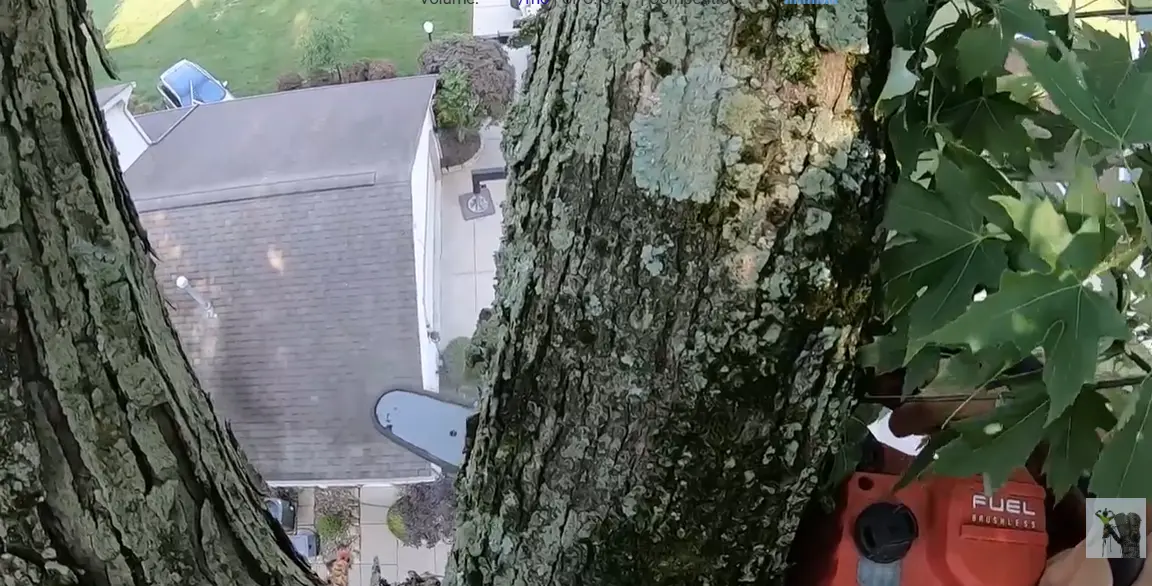
Not necessarily. A tree near a house isn’t automatically a removal candidate just because of its location. Many mature trees near structures have stood for decades without incident.
The proximity is a reason to take a closer look, not a reason to assume removal is required. → Full tree risk assessment guide · Cabling and bracing as an alternative
Tree emergency near you? A local crew is one call away.
📞 Call Now: (762) 470-0249Cost and Timing
Structure-adjacent removal costs more than open-yard removal of a similar tree, largely because of the slower sectional technique and, in some cases, crane costs. → Full cost breakdown
Rome & Floyd County Context
Many of Rome’s older neighborhoods have mature trees close to homes on tight lots. These include areas near downtown, Mount Berry, and East Rome. Tree removal near a house is routine work here.
This applies across Rome (ZIP codes 30161, 30162, 30165) and surrounding Floyd County communities including Armuchee, Cave Spring, Lindale, and Shannon.
Get a Local Estimate
Tell us about the tree and its location. We’ll connect you with an available local crew for tree removal near a house in Rome and Floyd County.
Storm damage right now? We answer 24/7.
📞 Call Now: (762) 470-0249Latest Articles
- How to Protect Your House and Yard During Tree Removal
- Branches Over Your Roof: When to Prune and When to Remove
- Tree Too Close to House? How Far Is Safe and What to Do
Related Guides
- Tree Too Close to House? How Far Is Safe and What to Do
- Branches Over Your Roof: When to Prune and When to Remove
- Does Insurance Pay to Remove a Tree Near Your House?
Frequently Asked Questions
Does a tree near my house always need a crane?
No — many structure-adjacent removals are handled with sectional rigging alone. A crane becomes the better option specifically when the tree’s size, lean, or lack of a safe landing zone makes rigging alone too limited.
How much yard space does a crane actually need?
It varies by crane size and the specific job. But adequate, stable access for the truck and enough clearance to position and operate the crane safely are both required.
A site visit is usually the only reliable way to confirm a specific property can accommodate one.
Will removal damage my lawn or landscaping?
Some impact is possible, particularly near equipment staging areas and the debris zone. But a crew that plans property protection in advance — plywood paths, protected planting beds, contained debris areas — minimizes this considerably.
Ask about their specific plan before work starts.
How long does a structure-adjacent removal typically take?
It depends heavily on tree size, technique required, and whether a crane is involved. A moderate sectional removal might take several hours, while a larger or more complex crane job can take the better part of a day.